
1.What Is a Credit Card ?

A credit card is a plastic payment card issued by a bank or financial institution that enables you to borrow money up to a pre-approved limit. They work on the principle that you can use the banks money for the purchase and re-pay it at a later date rather than your own money. Once you are issued with a credit card, there is a maximum amount you can borrow called a credit limit. The limit will depend on your income, financial records and previous credit history. You can get a credit card to use for internet shopping, ordinary shopping, bill payments or even the travel expenses.
2.How Does a Credit Card Work ?
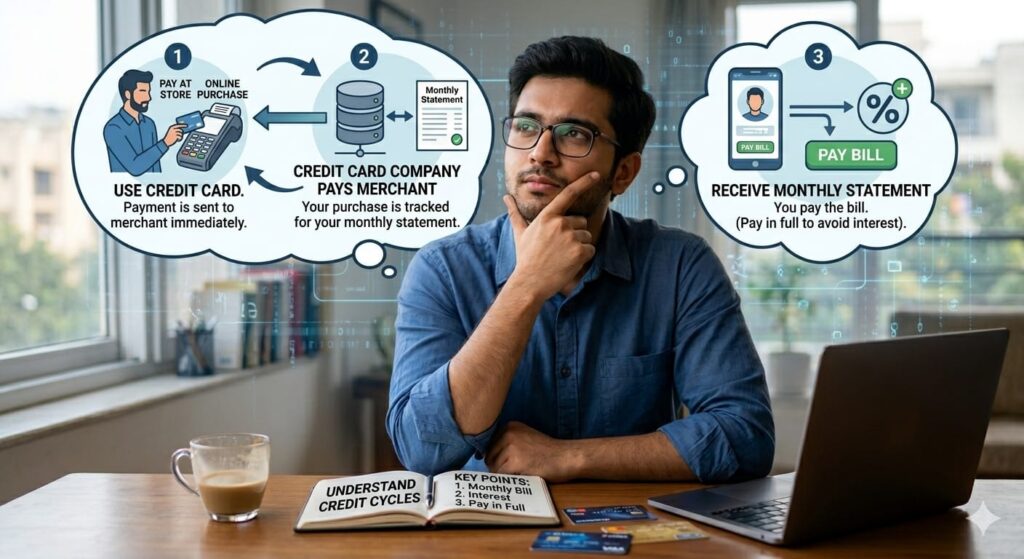
A credit card is a very straightforward credit facility. When you buy something, the bank or credit card company pays for it. At the end of the billing period, they send you a bill stating how much you spent and when your money is due to be paid. If you choose to pay your whole bill before the due date, you’re probably not going to be charged any more interest’ this will only be the case as long as you don’t miss the dates or pay very little of the bill. For example your credit card limit is $50,000. You buy a fridge costing $15,000, then your credit limit will now be $35,000. After repaying this the credit limit will go back to $50,000.
3.Benefits of Credit Cards
There are many benefits of credit cards if they are used responsibly.
– Builds Credit History
Make regular payments on time. Making regular payments builds your credit history. Having a good credit history might make it easier to be approved for future loans.
– Rewards and Cashback
A lot of credit cards offer bonuses, cashback and discounts on shopping, travelling, eating out, food delivery, online shopping and many other things.
– Easy Online Payments
Using a credit card for online transactions is easy and fast. Payments can be made in seconds without the need to carry cash.
– Emergency Financial Support
Unexpected expenses occur at any time. A credit card may be a financial lifeline in an emergency.
– Expense Tracking
Monthly balances enable the user to identify spending patterns and budget more efficiently.
4.Disadvantages of Credit Cards

While credit cards have many advantages, they also have a few disadvantages if they are not used wisely.
– High Interest Charges
Failure to pay the bill early may also result in the bank applying very high interest charges to the balance.
– Risk of Overspending
People are often overextending themselves financially simply because they have the additional credit.
– Late Payment Fee
Your credit score could be negatively affected if you don’t make your payments on time and/or incur extra bank charges because the due date has already passed.
– Debt Problems
Any long-term use of credit cards irresponsibly can risk high amounts of debt that quickly become unmanageable.
Example
Suppose you are having a credit card with the limit of $40000. You have used $ 10,000 for online purchase & $ 5000 for expenses on eating out. Therefore your bill has become $15,000 out of $40,000 available. If you make a payment on or before due date, no extra charges are levied. If not, then interest is charged on the outstanding amount.
Conclusion
Credit cards can be useful financial tools when used responsibly. They provide convenience, rewards, and opportunities to build a strong credit history. However, overspending and missing payments can lead to debt and financial stress. Understanding how credit cards work and using them wisely can help you enjoy the benefits while avoiding unnecessary financial problems.