
Hey!
I am Kushal from India.
Have you ever heard someone say make your money work for you? Well one of the main reasons why people say that is because of compound interest. It is known to many as the 8th wonder of the world because of all the potential that it holds to make a little money grow into a lot.
If you are new to personal finance and investing, compound interest may sound complicated. The good news is that the concept is actually very simple. In this beginner-friendly guide, you will learn what compound interest is, how it works, why it matters, and how you can use it to grow your wealth.

What Is Compound Interest ?
Compound interest is the interest you earn not only on your original money (called the principal) but also on the interest that has already been added to it.
In simple words, you earn interest on your interest.
This is what makes compound interest different from simple interest. With simple interest, you only earn interest on the original amount you invested. With compound interest, your money grows faster because the interest keeps getting added back to your balance.
Example :- Imagine you invest $1,000 in an account that pays 10% annual interest.
Year 1
- Starting balance: $1,000
- Interest earned: $100
- New balance: $1,100
Year 2
- Starting balance: $1,100
- Interest earned: $110
- New balance: $1,210
Notice what happened? In the second year, you earned interest on $1,100 instead of the original $1,000. The extra $100 from the first year also started earning interest.
This process continues year after year, causing your money to grow at an accelerating rate.
How Compound Interest Works
Compound interest works through three key factors :
1 Principal Amount
This is the initial amount of money you invest or save.
For example:
- Principal = $5,000
The larger your starting amount, the more money compound interest can generate.
2 Interest Rate
The interest rate determines how quickly your money grows.
For example:
- 5% interest rate
- 8% interest rate
- 12% interest rate
A higher interest rate generally leads to faster growth.
3 Time
Time is the most powerful factor in compound interest.
The longer your money stays invested, the more opportunities it has to compound.
Even small amounts can become significant when given enough time.
Why Compound Interest Is So Powerful
Most people underestimate the effect of compound interest because it grows very slowly at the start. But it can grow far faster after a certain period.

Let’s compare two investors :
Investor A
- Starts investing at age 25
- Invests $200 per month
- Continues for 10 years
Investor B
- Starts investing at age 35
- Invests $200 per month
- Continues until retirement
Despite having invested a smaller total of money, Investor A might still have a higher investment balance than Investor B due to the fact that their money had more time to grow.
This example highlights an important lesson :
Starting early is often more important than investing large amounts later.
Compound Interest Formula
The formula for compound interest is :

Where :
- A = Final amount
- P = Principal amount
- r = Annual interest rate
- n = Number of times interest is compounded per year
- t = Number of years
Don’t worry about the intimidating formula. The majority of us use online calculators or investing applications to find out the compound interest. What matters most is the concept that you will learn from it.
Compound Interest vs. Simple Interest
Let’s compare the two.
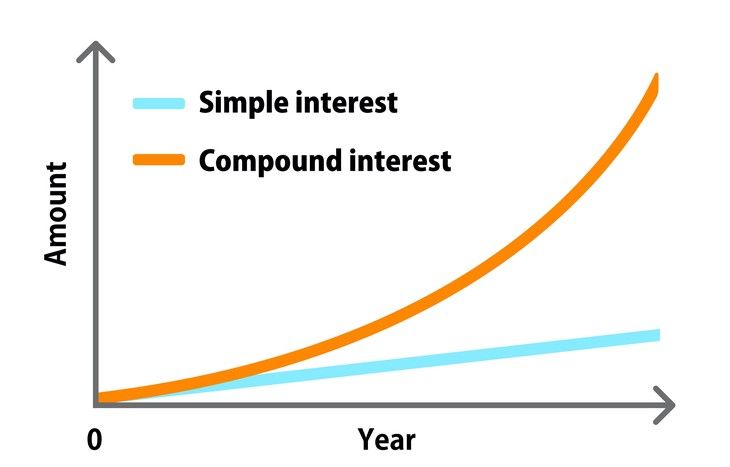
Suppose you invest $1,000 at 10% interest for 5 years.
Simple Interest
- Interest earned each year: $100
- Total interest after 5 years: $500
- Final amount: $1,500
Compound Interest
- Interest is added back to the balance every year
- Final amount after 5 years: approximately $1,610
This may seem small over five years, but it adds up to something massive over the long term.
This is why long-term investors prefer investments that benefit from compounding.
Real-Life Example of Compound Interest
Savings Accounts
Many banks offer compound interest on savings accounts. The interest earned is added to your balance, helping your savings grow over time.
Fixed Deposits and Certificates of Deposit
Many fixed-income investments use compound interest to increase returns.
Mutual Funds
The effect of profits and dividends being reinvested enables investors to realize the benefits of compounding in the long run.
Retirement Accounts
Retirement saving vehicles are just about the best examples of compound growth, since even if you stop making contributions, the contributions and the earnings on the investments keep compounding for years and even decades.
The Role of Compounding Frequency
Interest can be compounded at different intervals :
- Annually (once a year)
- Semi-annually (twice a year)
- Quarterly (four times a year)
- Monthly (12 times a year)
- Daily
Generally, the more frequently interest is compounded, the more money you earn.
For example, an account that compounds monthly usually generates slightly higher returns than one that compounds annually, assuming the same interest rate.
How to Take Benefits of Compound Interest

Here are some practical ways beginners can benefit from compounding:
Start Early
The earlier you start saving or investing, the more time your investments have to grow.
Over time, even modest amounts can have a powerful impact.
Invest Regularly
Try to add money every month.
Regular investing increases your principal and gives compounding more money to work with.
Reinvest Earnings
Reinvest anytime you are not obligated to take the interest, dividend or profit.
This provides extra returns on your returns.
Stay Invested
A lot of people assume the worst during market swings, and stop investing.
Compounding is most powerful when you can stay invested for the long haul.
Be Patient
Wealth created through compound interest rarely happens overnight.
The biggest gains often occur after many years of consistent investing.
Common Mistakes to avoid
Waiting Too Long to Start
Many people delay investing because they think they need a large amount of money.
In reality, it is usually more advantageous to begin early with a small sum of money than late with a large sum.
Withdrawing Earnings Frequently
Removing interest or investment gains reduces the power of compounding.
Chasing Unrealistic Returns
High-risk investments promising huge returns can lead to losses.
Focus on steady, long-term growth instead.
Ignoring Fees
Investment fees can reduce your overall returns and slow the compounding process.
Always pay attention to costs.
Final Thoughts
Compound interest is a topic that is one of the most useful tools that every freshman should know. This is because it means that your money not only grows from the money you initially invested, but also from the amount of money your investment makes.
The secret to benefiting from compound interest is simple: start early, invest consistently, reinvest your earnings, and stay patient.
To appreciate this profit from compounding, it is not necessary to have a large sum of money. Even small amounts of capital can turn into considerable sums over time. The earlier that you start the more impressive the effect.
In personal finance, time is often your greatest asset—and compound interest is the tool that helps you make the most of it.
Conclusion

Compound interest is one of the most effective ways to build wealth over time. Unlike simple interest, it allows you to earn returns not only on your initial investment but also on the interest or profits that have already been added to your money. This “interest on interest” effect can significantly increase your savings and investments in the long run.
The key to maximizing the benefits of compound interest is to start as early as possible, invest consistently, and remain patient. Even small amounts invested regularly can grow into a substantial sum when given enough time. Whether you’re saving for retirement, building an emergency fund, or working toward a financial goal, compound interest can help you get there faster.
Remember, successful investing is not always about investing large amounts of money—it’s often about giving your money enough time to grow. The earlier you begin, the greater the power of compounding will be. That’s why understanding and using compound interest is one of the smartest financial decisions a beginner can make.