
Hey !
I am Kushal from India.
When I first started learning about banking, I was confused about the difference between a Savings Account and a Current Account. Many beginners face the same confusion because both accounts are offered by banks and can be used to deposit and withdraw money.
While there are similarities between the two accounts, they are entirely distinct in their practice. In this guide, I will try to explain the differences of a Savings Account and a Current Account as simply as possible so that it can be understood by anyone.
What Is a Savings Account ?

A Savings Account is a bank account designed for people who want to save money while keeping it safe. It is one of the most common types of bank accounts and is suitable for students, salaried employees and peoples.
The main purpose of a savings account is to encourage saving habits and help people manage their personal finances.
Example:- if you receive a monthly salary and want to save some money for future needs, a savings account is a good choice.
What Is a Current Account ?

A Current Account is a bank account mainly designed for businesses, shop owners, freelancers and professionals who make frequent transactions every day.
Unlike a savings account, a current account is not meant for saving money. Instead, it helps businesses handle large numbers of deposits-withdrawals and money transfers.
Example:- if you own a shop and receive payments from customers daily a current account can make managing those transactions much easier.
Why Do Banks Offer Different Accounts ?
Many people wonder why banks offer both savings and current accounts.
The answer is simple.
People and businesses have different financial needs.
A student or a salaried employee generally requires a safe deposit account where he or she could place funds and earn interest Businessmen or businessmen prefer an account providing high volume transactions facility.
This is the reason banks offer different types of accounts.
Savings Account vs Current Account
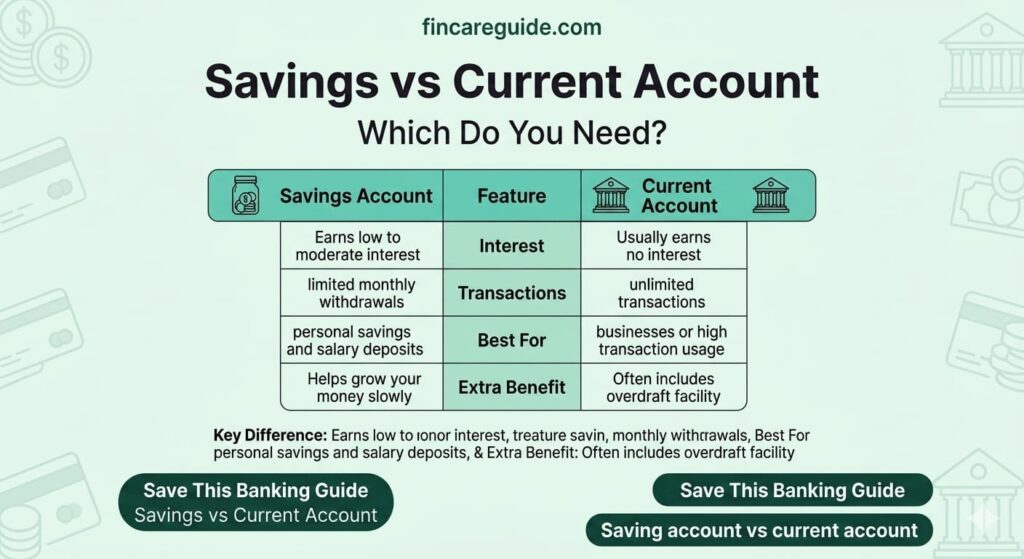
Let’s understand the major differences between these two accounts.
1. Purpose
Saving Account
A savings account provides personal savings and financial security.
Current Account
A current account is used to carry out business transactions and receive and make daily payments.
2. Interest Earnings
Saving Account
Most savings accounts pay you interest on the money you put in.
Example:- The bank will give you a little bit of interest if you have held money in an account for a long period of time.
Current Account
Most current accounts do not provide interest because they are mainly used for business transactions.
3. Suitable Users
Savings Account
- Students
- Salaried employees
- Homemakers
- Peoples
Current Account
- Business owners
- Shopkeepers
- Startups
- Freelancers
- Companies
4. Number of Transactions
Savings Account
Savings accounts may have certain limits or restrictions depending on the bank.
Current Account
Current accounts are intended for regular, high-volume activity. So are well suited to a business.
5. Minimum Balance Requirement
Savings Account
Many savings accounts require a lower minimum balance.
Current Account
Current accounts often require a higher minimum balance compared to savings accounts.
6. Overdraft Facility
Savings Account
Most savings accounts do not provide overdraft facilities.
Current Account
Many banks also offer overdraft facilities with current accounts. This will allow customers to ‘overdraw’ their account for a certain amount up to a specified limit.
7. Business Usage
Savings Account
Not recommended for regular business transactions.
Current Account
Specifically designed for business operations and professional use.
Which Account Is Better ?
One of the most common questions beginners ask is :
The truth is that neither account is better than the other. They simply serve different purposes.
If your goal is to save money and earn interest, a savings account is the better option.
If you own a business and handle multiple transactions every day, a current account is more suitable.
The right choice depends on your financial needs.
Real Life Example
Imagine two people.
Rahul works in a private company and receives a monthly salary. He wants to save money for emergencies and future goals.
For Rahul, a savings account is the right choice.
Now imagine Aman owns a clothing store. Every day he receives payments from customers and pays suppliers.
For Aman, a current account is the better option because it supports frequent business transactions.
Common Mistakes Beginners Make
In my opinion the biggest mistake that would be traders make is finding an account before knowing what they are going to do with it.
Some common mistakes include :
- Using a current account for personal savings
- Opening a savings account for business transactions
- Ignoring minimum balance requirements
- Not checking bank charges
- Choosing an account without comparing features
Understanding your financial needs can help you avoid these mistakes.
Tips for Choosing the Right Account
Before opening an account, consider these tips :
- Identify your purpose
- Compare bank features
- Check account charges
- Review online banking services
- Understand minimum balance requirements
Taking a few minutes to compare options can save money and prevent future problems.

Conclusion
Savings Accounts and Current Accounts are two types of bank accounts, which serve different purposes. If you have money you need to save and want to earn interest on it, then a savings account is what you need. For traders and firms, a current account is more suitable, as it allows a larger number of transactions. Know what you need before choosing one of these accounts.