
Hi, I’m Kushal from India

When I first started learning about money and investing, the stock market was one topic that confused me the most. I would hear people talking about shares going up, markets crashing, IPOs, brokers, and stock exchanges, but I couldn’t understand how all these things were connected.
At one point, I thought the stock market was simply a place where people bought cheap shares and sold them at a higher price. Later, I realized there was much more to it.
The stock market is connected to businesses, investors, the economy, and even everyday products we use. Once I understood the basic idea, the whole topic became much easier.
So, if you’re a beginner and the stock market sounds complicated, don’t worry. In this guide, I’ll explain it in simple language, without using unnecessary financial jargon.
What Is a Stock Market?

The stock market is a marketplace where shares of publicly listed companies are bought and sold.
A share represents a small ownership portion of a company.
For example, imagine a company is divided into millions of small pieces. Each piece represents a share. When you buy some of those shares, you become a small shareholder in that company.
You don’t have to own a large percentage of a company to be an investor. Even a small number of shares represents a small ownership interest.
In simple words:
The stock market connects companies that want to raise money with investors who want to invest in those companies.
A Simple Real-Life Example
Let’s say your friend starts a small clothing business.
The business becomes successful, but your friend wants to open 20 more stores. He needs a large amount of money to expand.
Instead of borrowing all the money, imagine he divides the business into many small ownership portions and offers some of them to investors.
People who buy those portions become part-owners of the business.
A public company works on a much larger scale.
Instead of asking a few friends or family members for money, a company can offer shares to a large number of public investors.
This is one of the basic ideas behind the stock market.
Why Do Companies Sell Shares?
A company needs money to grow.
It might want to:
- Build a new factory
- Open more stores
- Develop new products
- Enter new markets
- Buy another business
- Invest in technology
- Repay certain debts
One way to raise money is through borrowing.
Another way is to raise money by selling shares.
When a company offers shares to the public for the first time, this process is known as an Initial Public Offering, or IPO.
After the company becomes publicly listed, its shares can generally be bought and sold by investors on a stock exchange.
What Is a Share?
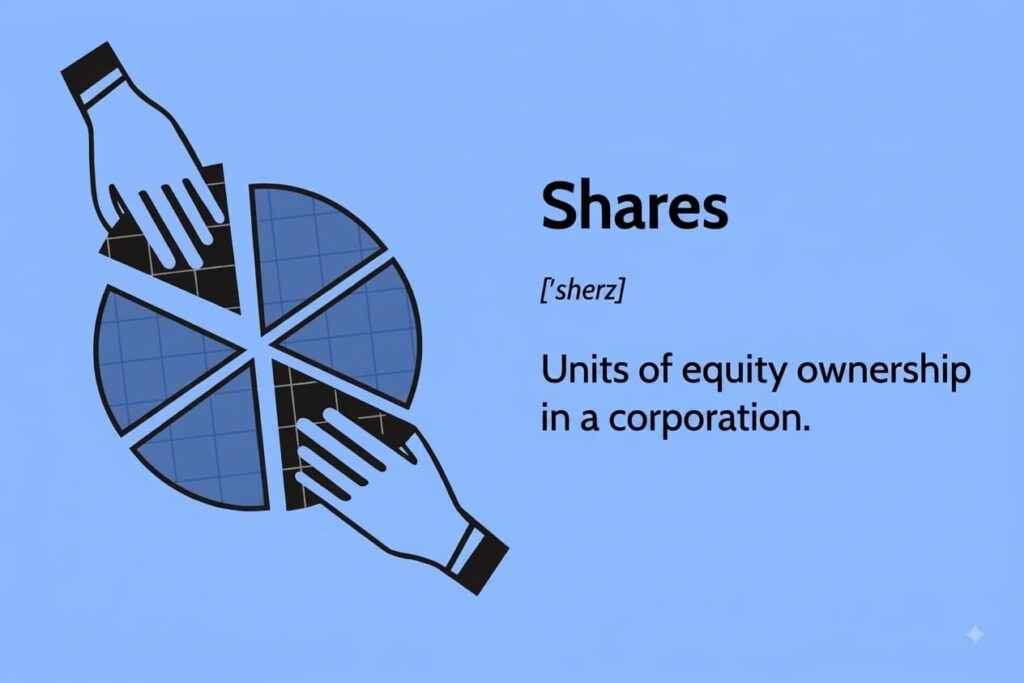
A share is a unit of ownership in a company.
Let’s say a company has 10 lakh shares and you own 100 of them.
You own a very small part of that company.
Your percentage ownership would be small, but you are still a shareholder.
The price of those shares can change over time depending on several factors, including company performance, investor demand, economic conditions, and market sentiment.
What Is a Stock Exchange?
Another term that confused me when I started learning was stock exchange.
A stock exchange is an organized marketplace where securities such as shares can be traded.
In India, two well-known stock exchanges are:
- Bombay Stock Exchange (BSE)
- National Stock Exchange (NSE)
You can think of a stock exchange as the marketplace where buyers and sellers come together to trade listed securities.
However, as an individual investor, you generally don’t walk into an exchange and buy shares directly.
You normally use a stockbroker or investment platform to place your orders.
How Does Buying a Stock Work?

The process may sound complicated, but the basic idea is simple.
Suppose you want to buy shares of a listed company.
First, you need the appropriate investment accounts and access to a broker.
You then search for the company and enter the number of shares you want to buy.
If your order matches with a seller under the applicable market conditions, the transaction takes place.
The shares are then credited to your investment account according to the settlement process.
Why Do Stock Prices Go Up and Down?

This was probably the most confusing part for me.
Why does one company’s share price rise today and fall tomorrow?
One major factor is supply and demand.
If more investors want to buy a stock than sell it, the price can rise.
If more investors want to sell than buy, the price can fall.
But demand itself is influenced by many things.
For example:
- Company profits
- Future growth expectations
- Economic conditions
- Interest rates
- Industry developments
- Government policies
- Global events
- Investor sentiment
This is why stock prices can change even when a company’s business hasn’t changed dramatically overnight.
A Simple Example of Price Movement
Imagine a company announces that its profits have increased significantly.
Investors may believe the company could continue growing.
More people may want to buy its shares.
If demand increases, the share price may rise.
Now imagine the company reports disappointing results.
Investors may become less confident and start selling.
The price could then fall.
Of course, real markets are much more complicated, and prices don’t always move exactly as expected.
Is the Stock Market the Same as Gambling?
This is a question many beginners ask.
In my opinion, the answer depends heavily on how you approach investing.
If someone randomly buys shares without understanding the company, follows rumors, and tries to make quick profits based on price movements, that behavior can become highly speculative.
Investing, on the other hand, involves understanding businesses, evaluating risks, considering financial goals, and making informed decisions.
There is still risk in investing, but it doesn’t mean investing is automatically gambling.
Why Do People Invest in Stocks?
People invest in the stock market for different reasons.
One major reason is the possibility of long-term wealth creation.
When a successful company grows over many years, its shareholders may benefit through an increase in share value.
Some companies also pay dividends to shareholders.
However, neither share-price growth nor dividends are guaranteed.
The stock market can also experience significant declines, so investors need to understand the risks before investing.
What Are the Main Risks?
The stock market can provide growth opportunities, but it also carries risk.
Market Risk
The overall market can fall because of economic problems, global events, or changing investor expectations.
Company Risk
A particular company may perform badly, lose customers, face competition, or experience financial difficulties.
Volatility
Stock prices can move sharply over short periods.
Emotional Risk
Investors may make poor decisions because of fear, greed, or panic.
For beginners, emotional decision-making can sometimes be as dangerous as choosing a poor investment.
My Experience Learning About Market Falls
When I first saw discussions about a market crash, I wondered why investors didn’t simply sell everything before prices fell.
The problem is that nobody can consistently predict exactly when a market will rise or fall.
That’s one reason I started understanding the importance of having a long-term plan instead of reacting to every daily price movement.
A falling market can feel scary, especially when you see the value of your investments dropping.
But making a decision purely because you’re frightened can sometimes make the situation worse.
What Is a Bull Market?
A bull market generally refers to a period when stock prices are rising or investor confidence is strong.
During such periods, people may feel optimistic about the economy and companies.
You may hear people say, “The market is bullish.”
What Is a Bear Market?
A bear market generally refers to a period of significant market decline and weak investor sentiment.
During these periods, investors may become worried about economic conditions and company earnings.
The important thing for beginners to understand is that both rising and falling markets are part of investing.
What Is a Stock Market Index?
A stock market index tracks the performance of a selected group of stocks.
In India, examples include the Nifty 50 and Sensex.
Instead of looking at every listed company individually, an index can give investors a broad indication of how a particular group of stocks is performing.
For example, if a major index rises, it generally indicates that the group of companies represented by that index has performed positively overall.
An index itself is not the same thing as an individual company.
Stock Market vs Stock Exchange
These terms are often used interchangeably, but there is a small distinction.
The stock market is the broader concept of buying and selling securities.
A stock exchange is a specific organized marketplace where listed securities are traded.
Think of “stock market” as the larger world and “stock exchange” as one of the marketplaces within that world.
Can Beginners Invest in the Stock Market?
Yes, beginners can learn to invest, but there is no need to rush.
Before investing, it’s useful to understand:
- What stocks are
- How stock exchanges work
- What risks are involved
- How diversification works
- What your financial goals are
- How much risk you can realistically handle
You don’t need to become a financial expert before learning the basics.
But you should avoid investing money you cannot afford to lose or money that you may need for immediate expenses.
A Real-Life Example
Imagine two beginners, Rahul and Aman.
Rahul
Rahul hears about a stock from a friend and buys it immediately.
He doesn’t know what the company does or why he is buying it.
When the stock falls by 15%, he becomes nervous and sells.
Aman
Aman spends time learning about the company and understands that stock prices can fluctuate.
He also diversifies his investments and invests according to his long-term financial plan.
Aman may still experience losses because investing always involves uncertainty, but his decisions are based more on a plan than on panic.
This example taught me that having a strategy can be more important than constantly watching the market.
Common Stock Market Mistakes Beginners Make

- Expecting Quick Money
The stock market isn’t a guaranteed shortcut to wealth.
Trying to make fast profits can lead to unnecessary risk.
- Following Social Media Tips
A stock trending online isn’t automatically a good investment.
- Investing Everything in One Company
Putting all your money into one stock creates concentration risk.
- Checking Prices Constantly
Watching every small movement can encourage emotional decisions.
- Ignoring Research
Before buying a stock, understand what the company does and why you’re investing.
What I Learned About Long-Term Investing
The biggest change in my thinking happened when I stopped looking at the stock market as a place to make quick money.
Instead, I started seeing it as a way to participate in the growth of businesses.
A company doesn’t become successful because its stock price moves up for one week. Its long-term success depends on things like customers, products, management, competition, profits, and its ability to adapt.
That doesn’t mean every successful business will always have a rising stock price.
It simply means investors need to look beyond the daily numbers.
Is Investing in the Stock Market Safe?
There is no simple yes-or-no answer.
The stock market is not risk-free.
Your investment value can fall, sometimes significantly.
However, risk can be managed through proper research, diversification, suitable asset allocation, and a long-term approach.
The amount of risk you take should also match your financial situation.
Final Thoughts
The stock market may look complicated when you first hear terms like shares, exchanges, indices, IPOs, brokers, and market movements. But once you understand the basic idea, everything starts connecting.
At its core, the stock market is a marketplace where investors can buy and sell ownership in publicly listed companies.
For companies, it can provide access to capital. For investors, it provides an opportunity to participate in the growth of businesses.
But investing isn’t about guessing which stock will rise tomorrow.
In my opinion, beginners should focus first on learning how the market works, understanding risk, and building good financial habits.
You don’t need to know everything on day one.
Start with the basics, ask questions, learn from reliable sources, and make decisions based on your own financial goals.
The stock market rewards patience far more often than excitement.