
Hi, I’m Kushal from India.
When I first became interested in investing, I thought the biggest question was, “Which investment gives the highest return?” I spent hours reading about stocks, mutual funds, SIPs, and even cryptocurrencies. But after some time, I realized I was asking the wrong question.
The more important question was:
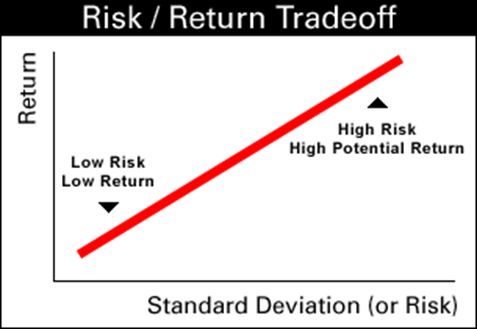
“How much risk am I taking to earn those returns?”
At first, I didn’t understand what people meant by “investment risk.” I assumed risk only meant losing all my money. Later, I learned that risk is much broader than that. Sometimes an investment doesn’t lose money—it simply doesn’t grow enough to help you achieve your financial goals.
That changed the way I looked at investing.
If you’re just starting your investment journey, this guide will explain what investment risk means, why it matters, the different types of risks, and how beginners can manage them in simple language.
What Is Risk in Investing?
Investment risk is the possibility that your investment may not perform as expected. It could mean losing money, earning lower returns than expected, or not reaching your financial goals on time.
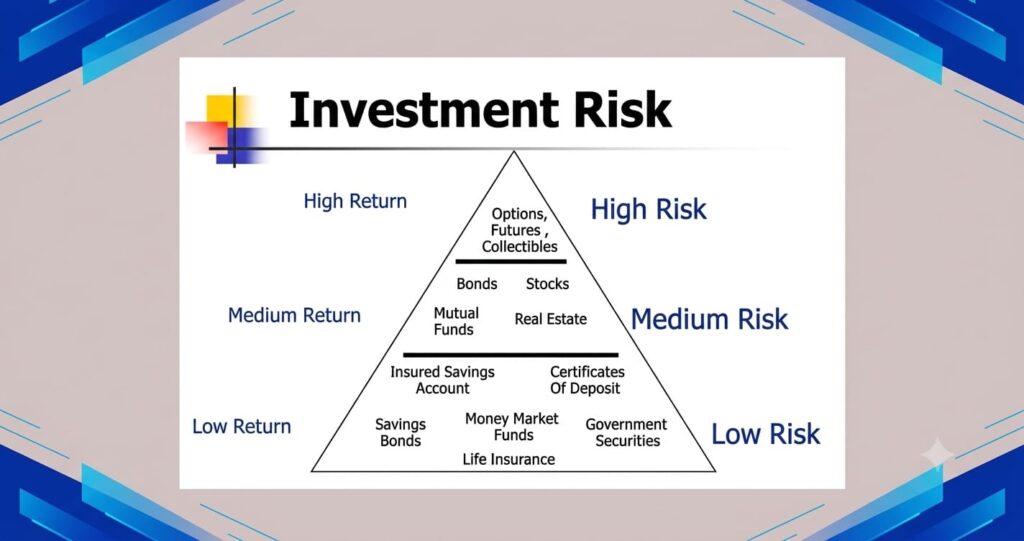
In simple words:
Risk is the chance that the outcome of your investment may be different from what you hoped for.
Every investment carries some level of risk. The only difference is that some investments are riskier than others.
A Simple Real-Life Example
Imagine two friends each have $1000 to invest.
Rahul keeps his money in a savings account. His money is safe, but it grows slowly.
Aman invests in the stock market. His investment may grow faster, but its value can also rise and fall.
Neither option is completely right or wrong. They simply involve different levels of risk and return.
This example helped me understand that risk isn’t always bad—it’s simply part of investing.
Why Does Investment Risk Exist?
Many beginners ask,
“Why can’t every investment give high returns without any risk?”
The answer is simple.
If an investment could guarantee very high returns without any risk, everyone would invest in it.
Generally, investments with higher return potential also involve higher uncertainty.
That’s why investors must balance risk and reward.
My Experience Learning About Risk
When I first started learning, I believed the safest investment was always the best.
Later, I realized something important.
Keeping all my money in low-return investments could also become risky because inflation slowly reduces purchasing power.
That taught me there isn’t just one kind of risk.
Sometimes playing it too safe also has disadvantages.
Types of Investment Risk
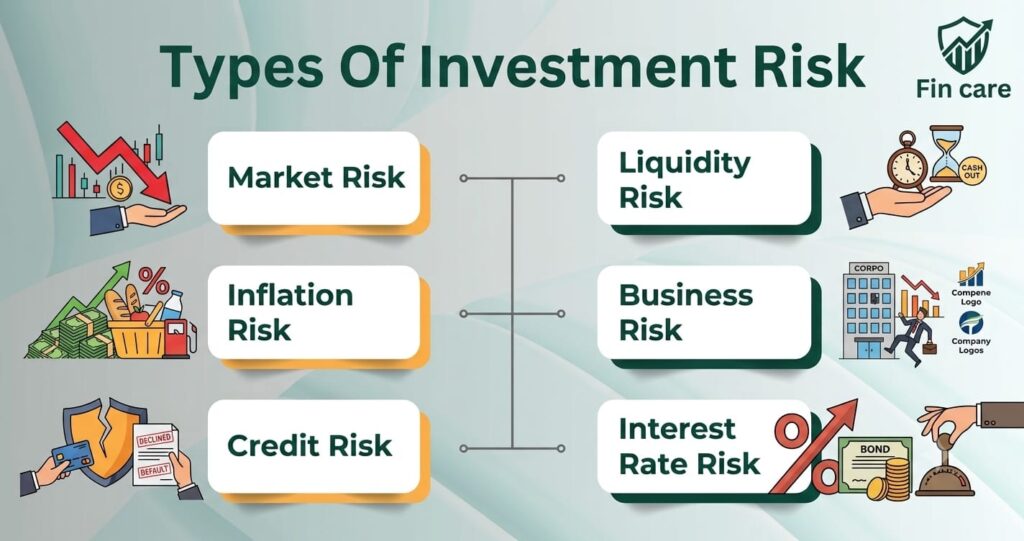
Let’s understand the most common risks beginners should know.
1. Market Risk
Market risk is the possibility that investment prices fall because the overall market declines.
For example, even good companies may see their share prices drop during an economic slowdown.
This is one of the most common investment risks.
2. Inflation Risk
Inflation means prices increase over time.
If your investment grows slower than inflation, your money loses purchasing power.
For example:
Suppose your savings grow by 4% annually but inflation is 6%.
Technically your money increased, but its buying power actually decreased.
3. Credit Risk
Credit risk mainly affects investments where someone promises to repay money.
If they fail to repay, investors may suffer losses.
This risk is more common in bonds and lending-related investments.
4. Liquidity Risk
Liquidity means how quickly you can convert an investment into cash.
Some investments can be sold easily.
Others may take weeks or even months.
If you suddenly need money, low liquidity can become a problem.
5. Business Risk
When you buy shares of a company, you’re investing in its business.
If the company performs poorly, your investment may lose value.
This is why understanding a company’s business is important.
6. Interest Rate Risk
Changes in interest rates can affect certain investments like bonds.
When interest rates change, investment values may also change.
Beginners don’t need to master this immediately, but it’s useful to know the concept.
Risk vs Return
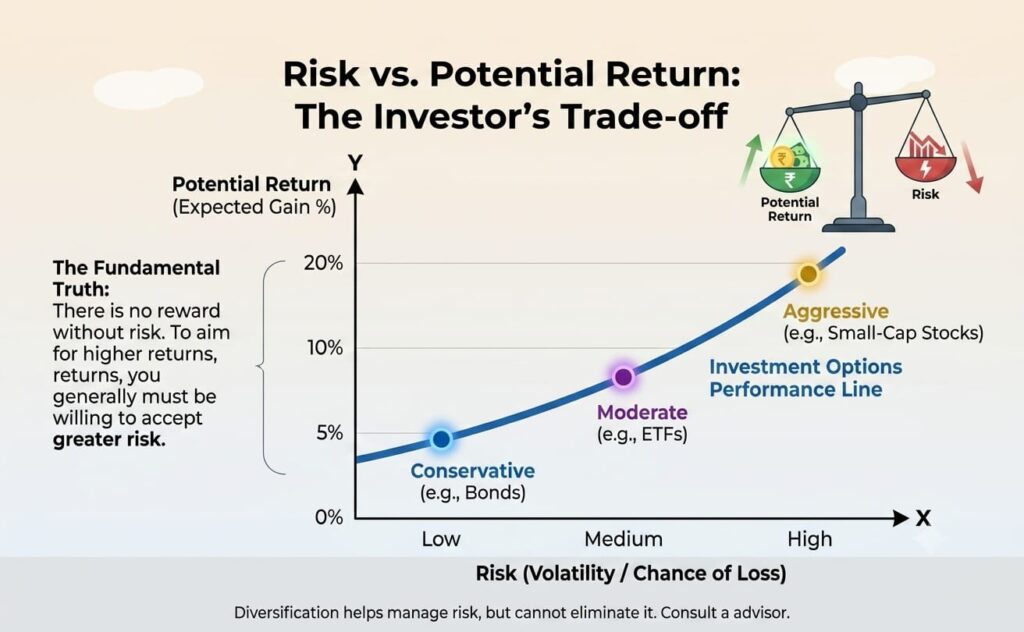
One of the biggest lessons I learned was this:
Higher returns usually come with higher risk.
For example:
- Savings Account → Lower risk, lower returns
- Fixed Deposit → Relatively low risk
- Mutual Funds → Moderate risk
- Stocks → Higher risk
- Cryptocurrency → Very high risk
This doesn’t mean high-risk investments are always better.
The right investment depends on your goals and comfort level.
Can Risk Be Eliminated?
No.
Risk cannot be completely removed.
However, it can be managed.
Successful investors don’t avoid risk completely.
They understand it and try to reduce unnecessary risk.
How Beginners Can Reduce Investment Risk
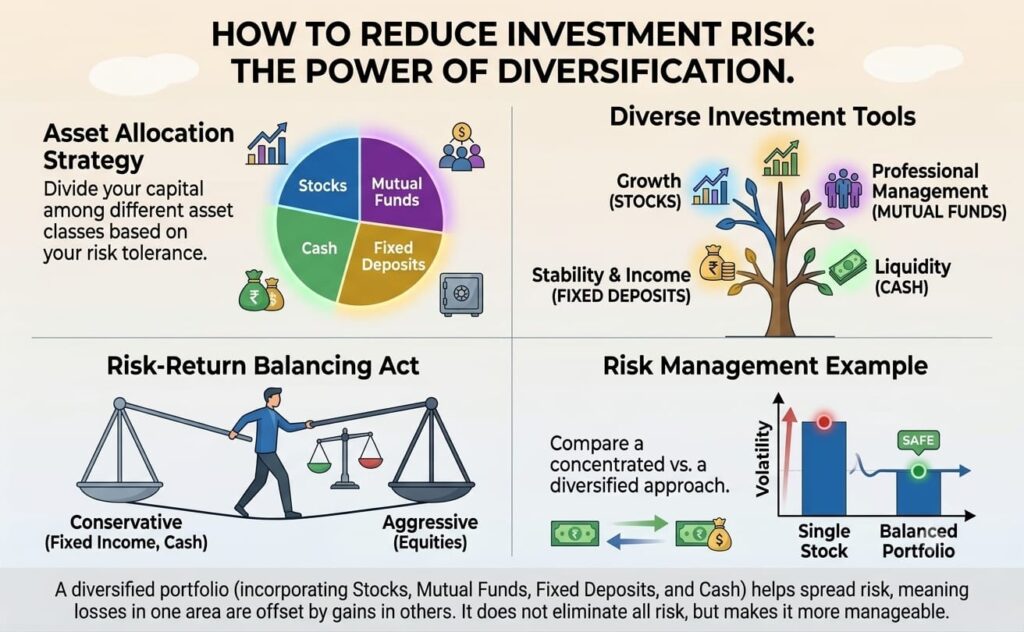
Diversify Your Investments
One of the best ways to reduce risk is diversification.
Instead of putting all your money into one company or one investment, spread it across different investments.
People often say,
“Don’t put all your eggs in one basket.”
This simple saying explains diversification perfectly.
Invest for the Long Term
Markets naturally move up and down.
Long-term investors usually worry less about short-term fluctuations.
Patience often becomes an advantage.
Learn Before Investing
The more knowledge you have, the better your decisions are likely to be.
Never invest just because someone else recommends it.
Understand what you’re investing in.
Keep an Emergency Fund
Never invest money you may need next month.
Unexpected expenses happen.
An emergency fund helps prevent panic selling.
Invest According to Your Goals
Someone saving for retirement may choose different investments than someone saving for a vacation next year.
Your investment should match your financial goals.
Common Mistakes Beginners Make
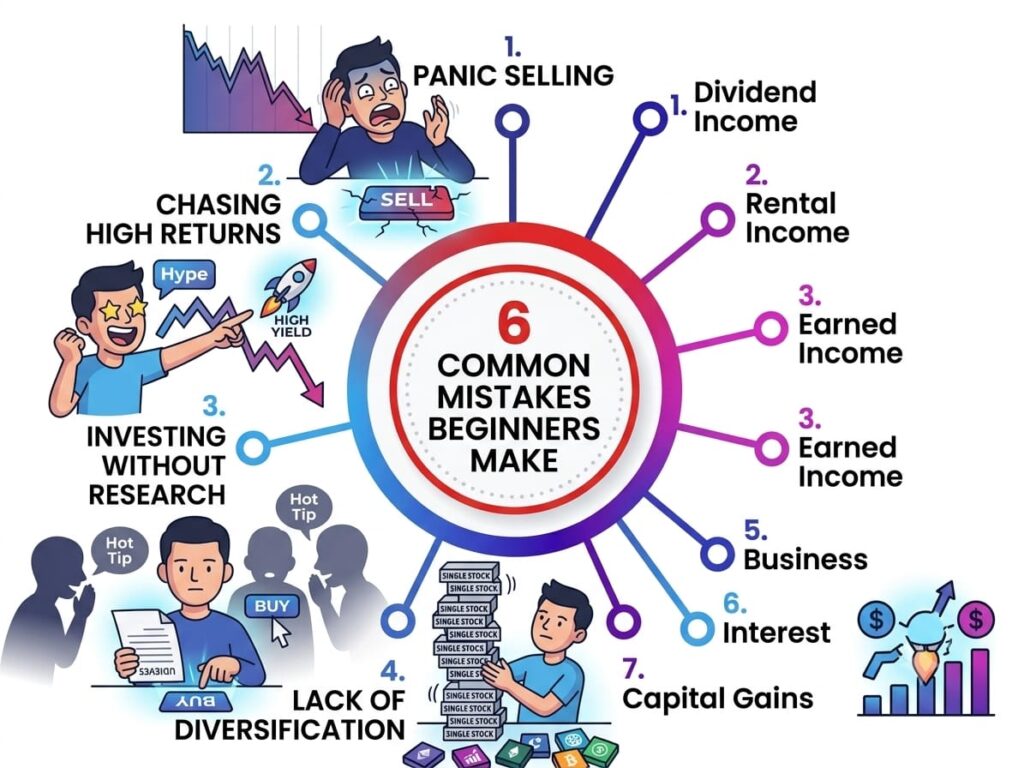
In my opinion, these are some of the biggest mistakes.
Thinking High Returns Are Guaranteed
No investment guarantees high returns.
Always be cautious of unrealistic promises.
Following Friends Without Research
Your friend’s financial goals may be completely different from yours.
Make your own informed decisions.
Panicking During Market Falls
Temporary declines are a normal part of investing.
Emotional decisions often lead to poor outcomes.
Ignoring Risk Completely
Many beginners only focus on returns.
Understanding risk is equally important.
Investing Without a Plan
Having clear financial goals helps you choose investments more wisely.
A Real-Life Example
Imagine two cousins.
Rohan
Rohan invests all his savings in one company’s shares because he heard they would rise quickly.
Unfortunately, the company performs poorly, and he loses a large portion of his investment.
Neeraj
Neeraj divides his money between different investments like mutual funds, fixed deposits, and stocks.
When one investment performs poorly, the others help reduce the overall impact.
This example taught me why diversification is so valuable.
Does Age Affect Investment Risk?
Yes.
A younger investor with long-term goals may be able to take more investment risk because they have more time to recover from market fluctuations.
Someone close to retirement may prefer relatively lower-risk investments.
Everyone’s situation is different.
My Personal View on Investment Risk
The biggest lesson investing taught me is that risk isn’t the enemy. Ignorance is.
Taking informed risks after learning about an investment is completely different from blindly chasing quick profits.
The more I learned, the less I worried about short-term market movements and the more I focused on long-term financial goals.
That mindset helped me understand investing with greater confidence.
Final Thoughts
Every investment involves some level of risk, whether it’s a savings account, fixed deposit, mutual fund, or stock market investment.
The goal isn’t to avoid risk completely—it is to understand it, manage it wisely, and choose investments that match your financial goals and comfort level.
For beginners in 2026, the smartest investment isn’t necessarily the one with the highest return.
It’s the one you fully understand.
Because successful investing isn’t about taking the biggest risks.
It’s about making informed decisions, staying patient, and allowing time to work in your favor.

Conclusion
Understanding investment risk is one of the most important steps before investing your money. Every investment carries some level of risk, but that doesn’t mean you should avoid investing altogether. The key is to understand the risks, choose investments that match your financial goals, and avoid making decisions based on emotions or rumors.
In my opinion, one of the biggest mistakes beginners make is focusing only on potential returns while completely ignoring the risks involved. A smart investor doesn’t chase the highest returns—they focus on making informed decisions and managing risk wisely.
Remember, successful investing is not about avoiding risk completely. It’s about learning, staying patient, diversifying your investments, and thinking long term. The more you understand risk today, the more confident you’ll become in making better financial decisions for your future.